Why candy cascades resolve bottom-up, and how to plan around it
The single most useful habit in a cascade puzzle is reading the board from the bottom up. Candies fall downwards and are refilled from the top, so a clear near the bottom rewrites the arrangement of everything above it, while a clear near the top leaves the lower two-thirds of the board exactly as it was. This guide explains what that means for move selection.
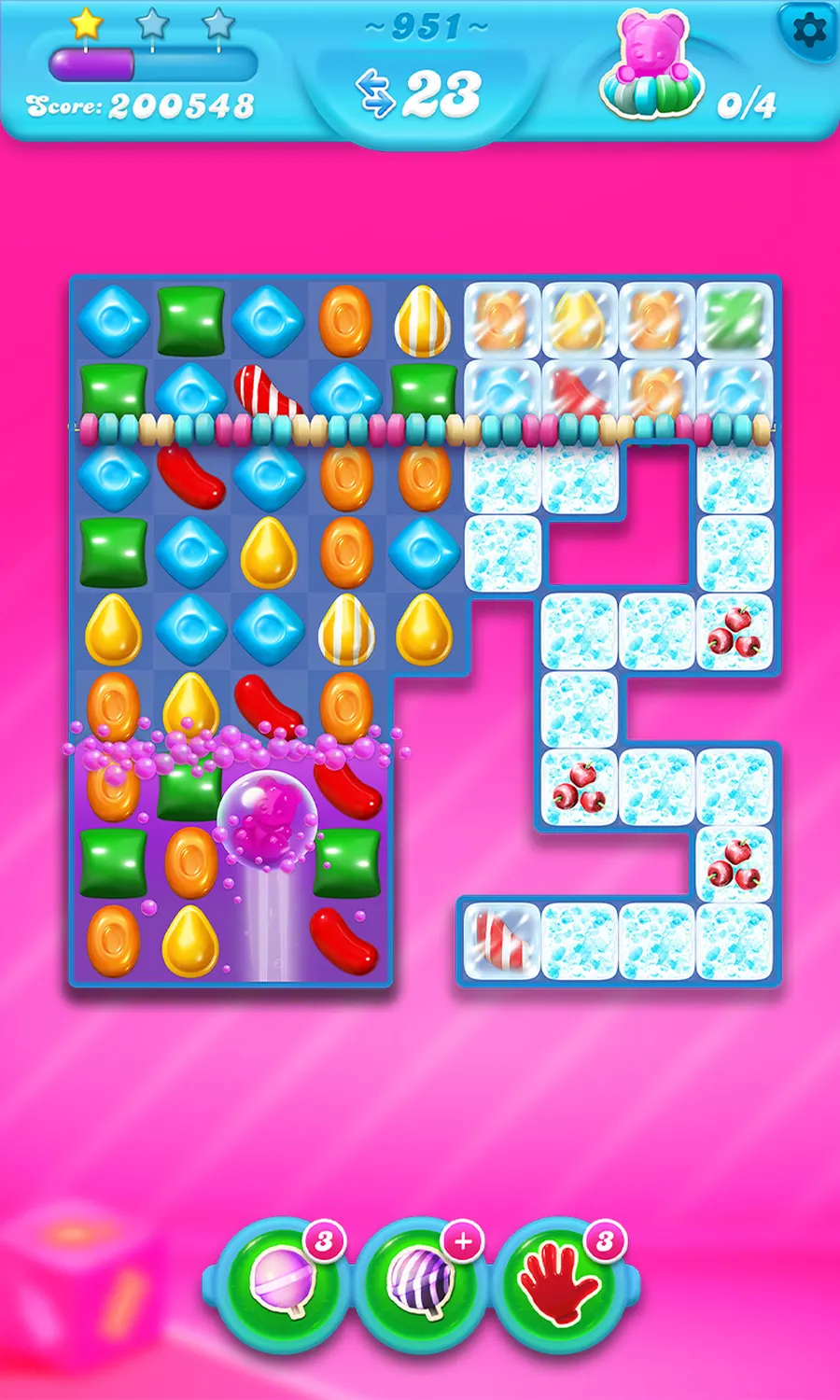
What a cascade actually is
When a match clears, the tiles above it drop into the gap and new candies enter from the top edge. If those new positions happen to form another match, it resolves automatically, and the process repeats until no automatic matches remain. Nothing about this is random in the sense that matters to you: the falling is deterministic, only the newly generated candies are not.
That distinction is the whole trick. You cannot control what enters the board, but you can control how much of the board is forced to rearrange. A low clear rearranges a lot. A high clear rearranges almost nothing.
Reading refill direction
Before swapping, ask three questions:
- Which column will empty as a result of this match?
- What is directly above that column, and will it land somewhere useful?
- Is there a second match already waiting in the two rows above, which the drop would complete?
If the answer to the third question is yes, you have found a chain, and it is almost always worth taking over a bigger match elsewhere on the board.
A worked example
Say the bottom row has three purple candies with a gap between the second and third, and directly above the gap sit two more purples. Matching the bottom row first drops those two purples into the row and completes a second match without spending a move. Matching the upper pair first breaks the pattern and produces nothing. Same candies, same board, one move of difference.
When the board stops cooperating
Boards do run dry. When no useful match is visible, the productive response is not to take the first legal swap you see, but to look for the move that opens the largest vertical column — even if that move itself scores little. Restoring vertical movement is usually worth one low-value move, because the refill will generate options you cannot currently see.
Objectives change the maths
All of the above assumes the objective can be advanced from anywhere on the board. It often cannot. If the goal is anchored in a specific area — a corner, a locked column, a set of tiles along one edge — then clearing near that area beats clearing low, because your progress bar only moves when the right tiles disappear. Read the goal first, then apply the bottom-up rule inside the region that matters.